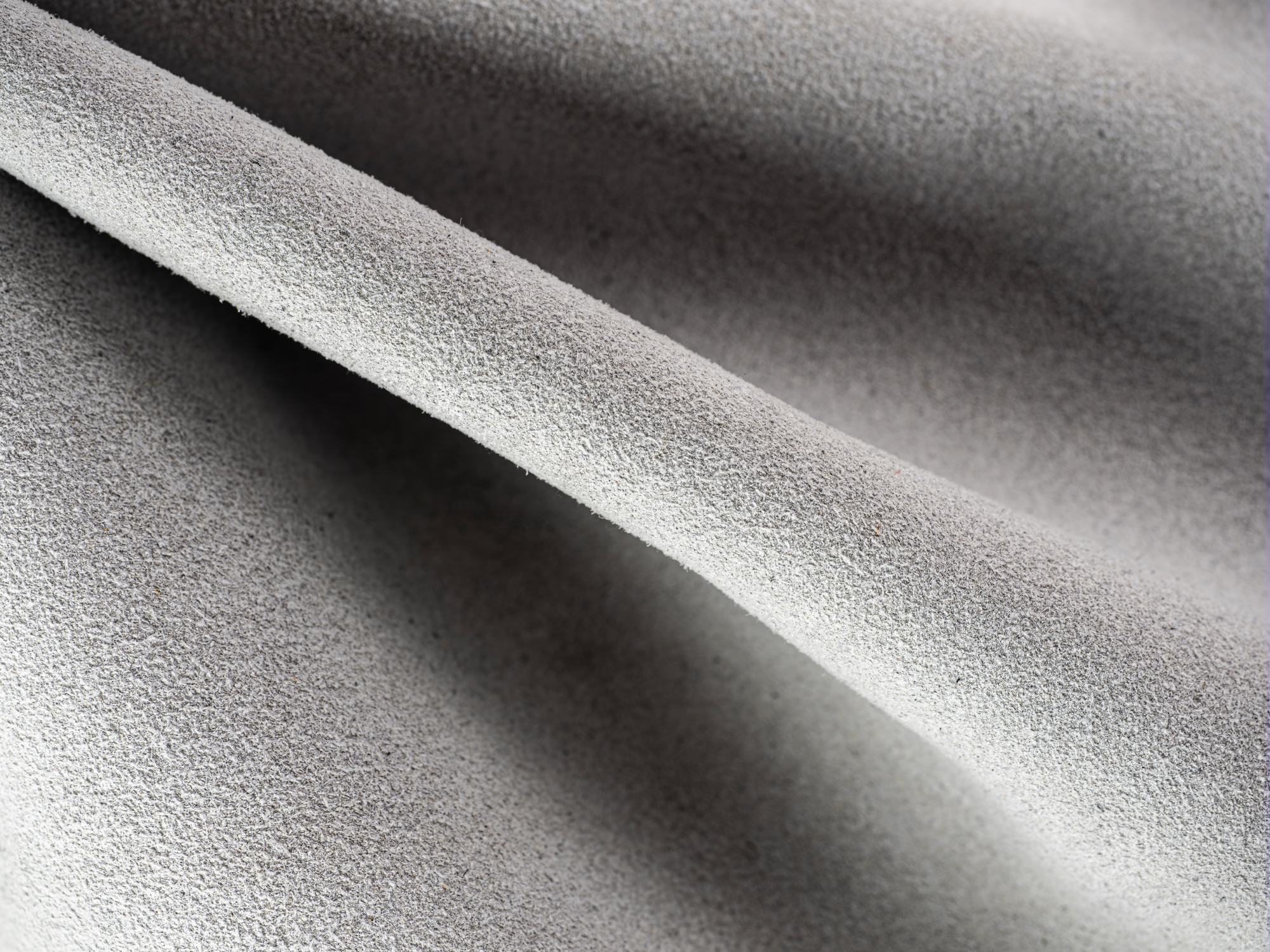
 The finished material, after entanglement and coating
The Technology, Explained
No chemical binders. No solvents. PELINOVA® is built by physics, high-pressure water anchoring leather fiber onto a woven TENCEL™ Lyocell core, not by chemistry gluing pieces together.
The finished material, after entanglement and coating
Hydro-Jet Technology is the process at the center of every PELINOVA® material. PELINOVA® starts from a woven TENCEL™ Lyocell core. High-pressure water jets then project loose leather fiber onto that core with enough force to drive the fiber into the weave and anchor it there. No adhesive holds the material together. The water pressure does the work that chemistry would otherwise be asked to do.
The process runs in a closed-loop water system, so the water is contained and reused rather than discharged. It is also part of why PELINOVA® uses 7 times less water than conventional leather production.
The result is a material that can be inspected and recertified at each stage, because every stage is a physical, measurable step rather than a proprietary chemical formula.
01
TENCEL™ Lyocell core woven
Lenzing TENCEL™ Lyocell fiber is woven into the base structure that the leather fiber will be projected onto.
TÜV SÜD · SGS · CTC · Intertek02
Leather fibers extracted
Pre-consumer offcuts from Guangdong tanneries are reduced to fiber, the raw input that gets projected onto the woven core.
TÜV SÜD · SGS · CTC · Intertek03
Hydro-jet projection and anchoring
High-pressure water jets project the leather fiber onto the woven TENCEL™ Lyocell core, driving it into the weave and anchoring it there. This is the step that gives the process its name, and where the structure of the material is actually formed.
TÜV SÜD · SGS · CTC · Intertek04
PFAS-free coating application
A water-based, solvent-free PU coating finishes the surface. PFAS-free, ISO 23702-1:2023 verified (CTC 2026), Recyc Leather SAS recertification in progress.
TÜV SÜD · SGS · CTC · IntertekMost engineered materials rely on an adhesive or a resin to hold fiber together. That approach works, but it also means the bond is a chemical formula, often proprietary, rarely fully disclosed, and difficult to audit independently.
Hydro-jet projection replaces that bond with a physical one. The leather fiber is driven into a woven TENCEL™ Lyocell core by water pressure and held there by the structure of the weave, not by adhesion. That distinction is what allows each stage of production, from the woven core to fiber projection to coating, to be independently tested and certified by TÜV SÜD, SGS, CTC, and Intertek rather than taken on faith.
A material that can be recertified as formulations or regulations evolve, without redesigning the underlying structure. It is also why PELINOVA® can state its PFAS-free status with a verified standard behind it: ISO 23702-1:2023, CTC 2026, rather than a general claim.
No. The leather fiber is anchored onto the woven TENCEL™ Lyocell core by high-pressure water. There are no chemical binders and no PVC in the structure itself.
The process runs in a closed-loop water system. PELINOVA® uses 7 times less water than conventional leather production.
Yes. Every stage, from the woven core to fiber projection to coating application, is certified by TÜV SÜD, SGS, CTC, and Intertek.
Across facilities in Southern China, within a single-region supply chain in Guangdong, which keeps fiber sourcing, weaving, projection, and finishing in the same traceable chain.
A sample tells you more than any specification sheet.